Biography

My research work focuses on cosmological simulations in the context of data analysis for large galaxy surveys. In particular, I work on modelling galaxy clustering and weak lensing observables and their statistical properties using simulations.

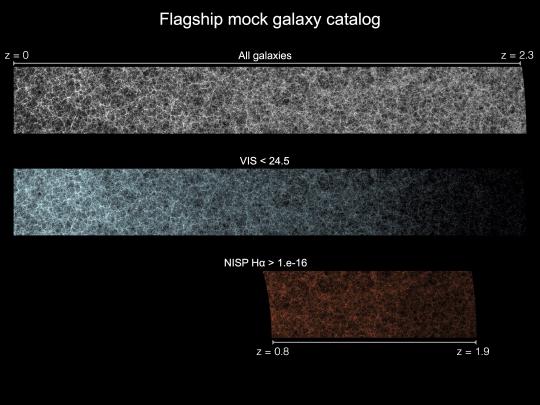
I am member of the Euclid Consortium, for which I produced large galaxy mock catalogues for testing the performances of the Euclid satellite, in collaboration with the Spanish Euclid data center at PIC.

I am part of the Exploring Dark Energy through Cosmic Structures project, for which I develop numerical methods to perform cosmological simulations of clustering dark energy scenarios.

Interests

  • Cosmology
  • Large Scale Structure
  • Computational methods
  • Dark Energy

Education

  • PhD in Astronomy & Astrophysics, 2015

    Observatory of Paris, France

  • MSc in Astrophysics & Cosmology, 2012

    University of Bologna, Italy

  • BSc in Astronomy, 2007

    University of Bologna, Italy
Experience


Project Assistant Professor

Kavli IPMU

December 2023 – Present Kashiwa, Japan


Postdoctoral Fellow

Max Planck Institute for Astrophysiscs

October 2018 – September 2023 Garching, Germany


Postdoctoral Researcher

Institute of Space Sciences

November 2015 – September 2018 Barcelona, Spain

Projects

Nefertiti: a cosmological simulation code for clustering dark energy scenarios

Euclid Flagship mock galaxy catalogue

The cosmological analysis of galaxy survey data requires modelling the large scale distribution of galaxies in synthetic realisations of the sky that are usually referred to as mock galaxy catalogues. These provide a controlled environment in which to test the impact of different aspects of the survey and allow to study the interplay of observational and statistical errors. For this reason they need to cover the same volume of the survey and to be statistically compatible with observed galaxy catalogues.

Covariance matrices from large ensembles of simulations

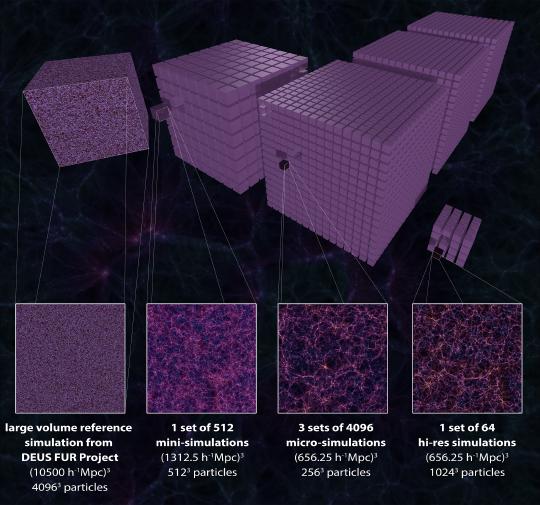
In order to extract the maximum amount of cosmological information from large scale structure surveys we need to make sure that we are able to model cosmological observables and their statistical errors at this unprecedented level of accuracy on the smallest scales that will be accessible to these surveys. This is where cosmological simulations are indispensable, since these scales are in the non-linear regime of gravitational collapse of cosmic structures, which cannot be modelled with analytical techniques.

Contact