Covariance matrices from large ensembles of simulations
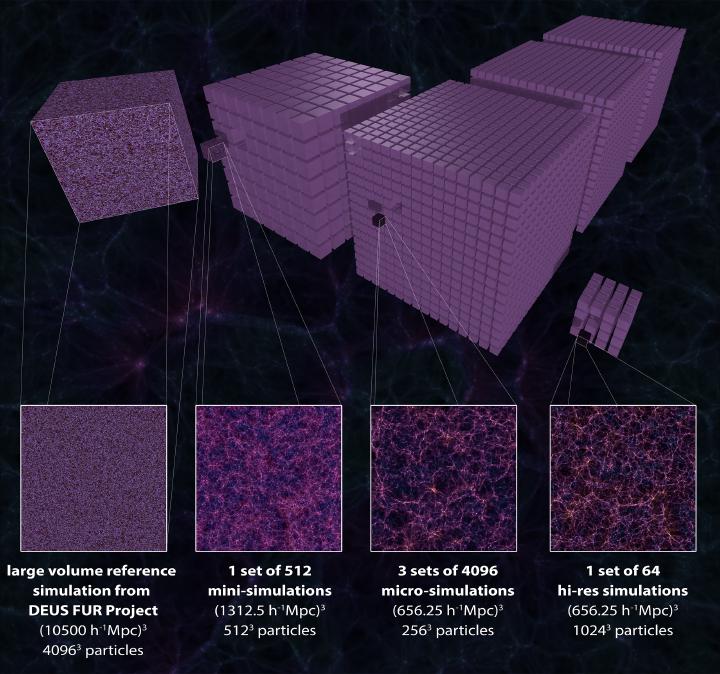 Credit: Deus Consortium
In order to extract the maximum amount of cosmological information from large scale structure surveys we need to make sure that we are able to model cosmological observables and their statistical errors at this unprecedented level of accuracy on the smallest scales that will be accessible to these surveys. This is where cosmological simulations are indispensable, since these scales are in the non-linear regime of gravitational collapse of cosmic structures, which cannot be modelled with analytical techniques. My work focused on estimating covariance matrices for large scale structure observables, which encode their statistical errors, using large ensembles of simulations.
The main cosmological observables of large galaxy surveys aim at indirectly measuring the underlying matter power spectrum, a second-order statistic that contains most of the cosmological information. This is why part of my research work focused on this quantity. In particular I have worked on the estimation of covariances from DEUS PUR, an ensemble of more than 12000 N-body simulations, exploring the effect of numerical systematics due to the limited mass resolution of the simulations ( Blot et al. 2015), the effect of non-linearities on the probability distribution function of the matter power spectrum and sample covariance estimators ( Blot et al. 2015 & 2016) and the information content of the power spectrum when combined with the third-order statistic: the bispectrum ( Chan & Blot 2017).
The DEUS PUR project produced the largest ensemble of simulations at the time of realisation, providing an invaluable resource for statistical studies of the properties of the dark matter density field in the non-linear regime. It was made possible by a Grand Challenge project at the IDRIS supercomputing centre. I was involved in all the stages of the project, from the production of the simulations to the subsequent analysis and interpretation of the results. The covariance matrices computed from these simulations are publicly available and have been used as a benchmark in numerous works aimed at predicting the covariance matrix from analytical methods.
Having such a large number of simulations allowed us to detect subtle effects that were previously undiscovered, such as the non-gaussianity of the distribution of the power spectrum estimator on non-linear scales ( Blot et al. 2015) and the impact of such non-gaussianity on the distribution of the sample covariance estimator ( Blot et al. 2016).